


“Meat the Future”
By: Jenilee Godsey
Twin Creeks Extension District
Youth Agriculture Agent
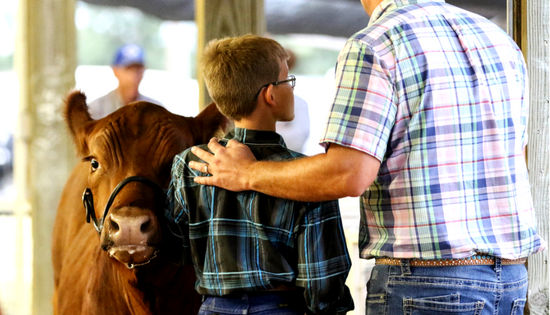
Here is an article I would like to share with you written by fellow K-State Research and Extension Agent, Michelle Beran, from the Midway Extension District. As we kick-off a new 4-H year, we as Extension Agents, get excited about the opportunity to work with existing and new volunteers in our 4-H programs. Volunteers play a crucial in the success of the program in regards to knowledge gained and skills advanced for our youth in their specific project areas. Take a look at Michelle’s message about mentoring in 4-H!
One of the important aspects of 4-H is providing practical learning opportunities for youth by working with caring adults who set examples and model behaviors. These adults provide invaluable opportunities as mentors for youth.
What is a mentor? A mentor is someone who listens, helps in goal setting, sets examples, and provides a framework for youth to learn problem solving, improve communication, and expand life skills.
Mentors have long-term impacts on the lives of youth and can exist in many different roles. We often think of mentors in one-on-one relationships but they can certainly exist as part of a group environment. They can include teachers, counselors, pastors, neighbors, family members and club/project leaders.
Good mentors will go to great lengths to assist, but also understand that the success of any young person depends on that youth’s choices and behaviors.
Even when a young person doesn’t show instant change and doesn’t seem to be benefitting from the relationship, the simple act of the mentor being there can be life-changing. Developmental or youth-centered mentoring relationships in which mentors help young people set and reach their own goals results in higher youth satisfaction compared to relationships in which the mentor just directs activities.
While it may sound like a mentor needs to be perfect or a super-hero to succeed, mentors are human and make mistakes. Mentors may take the wrong approach to a problem or say the wrong thing from time to time, but mentees are generally resilient as long as they understand that their mentors have the youth’s best interests at heart. Mistakes can give young people the chance to see an adult model good problem-solving skills and can be used as teachable moments.
Here are some great Do’s and Don’ts:
- DO be consistent – Many young people believe that adults aren’t dependable and mentors need to ‘walk the walk’ and make sure that our actions are consistent with our words.
- DO practice healthy communication skills – Establish eye contact, listen, ask questions for clarification, don’t interrupt and be open-minded.
- DO address inappropriate behavior – Do this directly but with care. Explain that there are standards in the outside world with which individuals are expected to comply. Behaviors learned in the home or among peers may be appropriate in those settings but not in others.
- DON’T trivialize your mentee’s feelings – Young people tend to lack the perspective that comes with age so your mentee may react more strongly in a given situation than an adult would. You may not understand why something is so important to your mentee but accept that it is and keep listening.
- DON’T jump to conclusions – Remember there are usually at least two sides to every story. It’s okay to give your mentee the benefit of the doubt but don’t choose sides or believe everything you hear. If you know the facts, then you’ll be in a better position to help your mentee find solutions and make wise choices.
If you are interested in being a mentor or volunteer in our 4-H program, we welcome you to contact any of our county offices!
Jenilee Godsey is a Youth Agriculture Agent for the Twin Creeks Extension District which covers Decatur, Norton, Graham and Sheridan counties. Email her at jenileem@ksu.edu or reach her by telephone at the Graham County Office, (785) 421-3411.